7 Marketing Books Every Marketing Professional Should Read
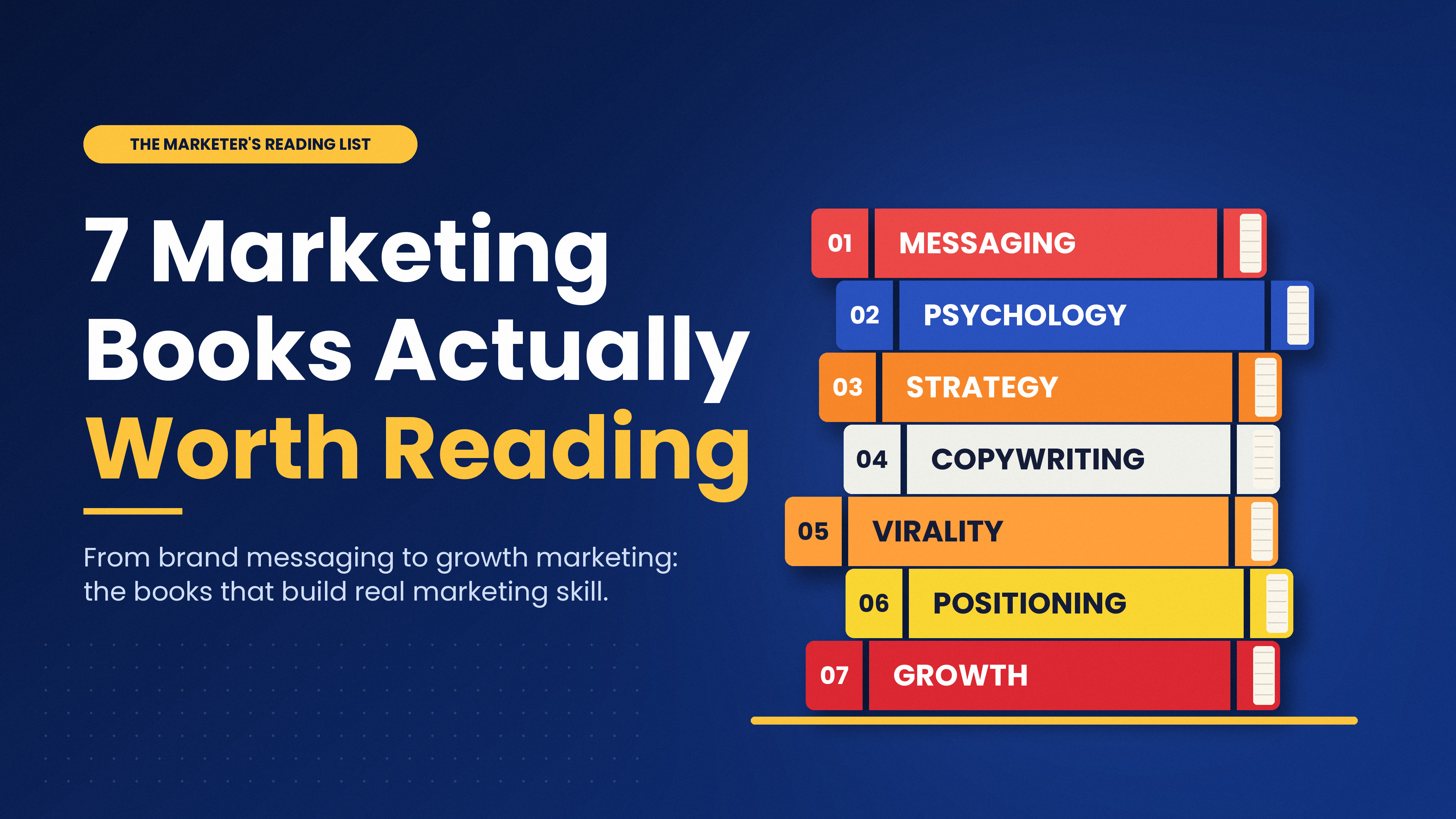
Seven books cover the core skills every marketer needs: messaging, psychology, strategy, copy, virality, positioning, and growth. Master these, and you will make better decisions than most people chasing the latest trend.
Marketing tools change every year. New platforms appear, algorithms shift, and AI rewrites the playbook overnight. Yet the fundamentals stay the same: people still buy from brands they understand, trust, and remember.
The books below are not quick hacks. Each one solves a specific problem marketers face every day. For each title, you will find who it is for, the big idea, and one action you can apply this week.
1. Building a StoryBrand by Donald Miller — for brand messaging
If customers cannot understand what you offer in a few seconds, they leave. Miller's book fixes that by turning your message into a simple story.
The big idea: Your customer is the hero, not your brand. Your brand is the guide who helps the hero solve a problem. Miller's seven-part framework walks through the character, the problem, the guide, the plan, the call to action, and what success or failure looks like.
Why it matters: Most brands talk about themselves. This book trains you to talk about the customer's problem first, which makes websites, ads, and pitches far clearer.
Try this: Rewrite your homepage headline so it answers three questions: what do you offer, how does it make life better, and what should the visitor do next?
2. Influence by Robert Cialdini — for consumer psychology
People rarely decide with pure logic. Cialdini, a psychology professor, spent years studying why people say yes, and this book explains the mental shortcuts behind those decisions.
The big idea: A small set of principles drives persuasion: reciprocity, commitment and consistency, social proof, authority, liking, scarcity, and (added in the new edition) unity, the pull of shared identity.
Why it matters: Reviews, free trials, limited offers, and expert endorsements all work because of these principles. Once you understand them, you can design campaigns on purpose instead of by luck.
Try this: Audit one landing page. Count how many principles it uses. Add one that is missing, such as customer testimonials (social proof) or a credible certification (authority).
A word of caution: These principles are powerful. Use them honestly. Fake scarcity and invented reviews may lift sales briefly, but they destroy trust.
3. This Is Marketing by Seth Godin — for marketing strategy
Godin challenges the idea that marketing means shouting at as many people as possible. He argues that good marketing is about serving people and creating change.
The big idea: Start with the smallest viable audience, the specific group of people you can truly serve. Earn their trust, understand their worldview, and let them spread your work.
Why it matters: Trying to reach everyone usually means connecting with no one. This book helps you choose a focus, which is the foundation of every strong strategy.
Try this: Finish this sentence for your brand: "Our product is for people who believe ___ , and it helps them ___." If you cannot fill it in clearly, your strategy needs work.
4. Ogilvy on Advertising by David Ogilvy — for copy that converts
First published in 1983, this classic still reads like a masterclass. Ogilvy built one of the world's best-known agencies, and he wrote the way he sold: clearly, with evidence.
The big idea: Advertising exists to sell, not to win awards. Do your research, know the product deeply, make a specific promise, and spend serious effort on the headline, because far more people read it than the body copy.
Why it matters: The media have changed from print to social feeds, but the craft has not. A clear benefit, a strong headline and proof still beat clever wordplay.
Try this: Before your next campaign, write ten headlines instead of one. Test the top two against each other and let the data choose.
5. Contagious by Jonah Berger — for understanding why ideas go viral
Virality is not luck. Berger, a Wharton professor, studied why some products and messages spread while others disappear, and he found clear patterns.
The big idea: The STEPPS framework names six drivers of sharing:
- Social currency: people share what makes them look good.
- Triggers: ideas tied to everyday cues stay top of mind.
- Emotion: high-arousal feelings, such as awe or excitement, drive sharing.
- Public: visible behaviour is easier to copy.
- Practical value: useful information gets passed on.
- Stories: a good narrative carries your message along with it.
Why it matters: Word of mouth is still one of the most trusted forms of marketing. This book shows you how to design for it.
Try this: Score your next piece of content against STEPPS. If it hits fewer than two drivers, rework it before you publish.
6. Obviously Awesome by April Dunford — for product positioning
A great product can still fail if customers do not understand what it is or why it matters. Dunford, a positioning consultant for tech companies, offers a practical method to fix this.
The big idea: Positioning is a deliberate choice, not an accident. Dunford breaks it into clear parts: competitive alternatives, unique attributes, the value those attributes deliver, the customers who care most, and the market category that makes your value obvious.
Why it matters: Strong positioning makes every other job easier, from sales calls to ad copy to pricing. Weak positioning makes even good marketing feel like pushing uphill.
Try this: Ask your best customers what they would use if your product did not exist. Their answers reveal your real competition, which is often not who you think.
7. Hacking Growth by Sean Ellis and Morgan Brown — for growth marketing
Sean Ellis coined the term "growth hacking." In this book, he and Morgan Brown turn the buzzword into a disciplined process used by fast-growing companies.
The big idea: Growth comes from rapid, structured experiments run by a cross-functional team. You find your product's core value, then test ideas across the full funnel: acquisition, activation, retention and monetisation.
Why it matters: Many teams spend most of their budget on acquisition while customers quietly leave. This book shows that retention and activation often deliver bigger, cheaper wins.
Try this: List five growth ideas. Score each from 1 to 10 on impact, confidence and ease. Run the highest-scoring test first, and review results every week.
Where to start
You do not need to read all seven at once. A practical order:
- Start with strategy: This Is Marketing, to decide who you serve.
- Define your place: Obviously Awesome, to position your product.
- Shape the message: Building a StoryBrand, to make it clear.
- Understand the buyer: Influence and Contagious, to learn why people act and share.
- Execute and scale: Ogilvy on Advertising for the copy, then Hacking Growth for testing and growth.
If you face one urgent problem, skip the order and read the book that solves it first.
Reading is only half the work. The marketers who grow fastest apply one idea at a time, measure the result, and keep what works. Pick one book, try one "Try this" action this week, and see what changes.
Which of these books has shaped your marketing the most? Share it with your team, and save this list for your next reading session.